Using an ABV Calculator is the most reliable way for homebrewers to determine the strength of their beer, cider, or mead. By comparing your gravity readings before and after fermentation, you can accurately track your alcohol percentage and ensure your yeast performed as expected.
How to Use the ABV Calculator
Calculating your homebrew’s strength doesn’t require a degree in chemistry. To get an accurate reading, follow these three simple steps:
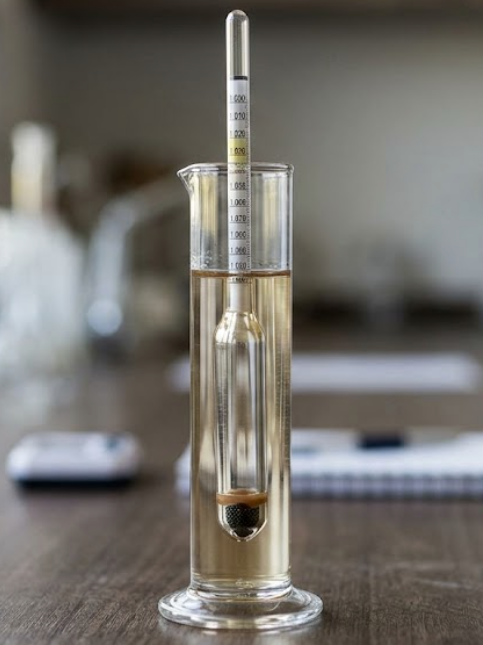
- Record your Original Gravity (OG): Use your hydrometer or refractometer to take a reading right before you pitch your yeast. This measures the sugar content in your unfermented wort.
- Record your Final Gravity (FG): Once fermentation has completely stopped (usually after 1–2 weeks), take a second reading.
- Plug in the Numbers: Enter both values into our calculator above. The tool will apply the standard brewing constant to reveal your drink’s Alcohol by Volume (ABV).
Pro Tip: Always ensure your sample is at the calibrated temperature of your hydrometer (usually 60°F or 68°F). If your wort is hot, your reading will be artificially low!
ABV Calculator
Want to save this result?
Everything you need to brew better beer.
In one place.
Save your ABV results, track every batch, design professional labels, and brew alongside us live every month. Free to join — no card required.
Free forever. No credit card required. Founding member pricing still open.
The Math Behind the Magic: The ABV Formula
While our tool does the heavy lifting, many brewers prefer to know the "why" behind the percentage. The standard formula used by hobbyists and professional craft brewers alike is:
ABV = (OG - FG) x 131.25
Why 131.25?
This number is a constant that accounts for the relationship between the weight of ethanol and the density of the liquid. For very high-gravity beers (like Imperial Stouts or Barleywines), some brewers use an alternate, more complex formula, but for 95% of homebrews, this calculation is the industry gold standard.
Why Measuring Gravity Matters
Measuring your gravity isn't just about knowing how "boozy" your beer is. It is the only way to track the health of your fermentation.
- Confirming Fermentation: If your gravity hasn't changed over 48 hours, your yeast may be stalled.
- Safety (Preventing "Bottle Bombs"): Bottling beer before it reaches its predicted Final Gravity can lead to over-carbonation and exploding bottles.
- Efficiency: Tracking OG helps you understand how much sugar you successfully extracted from your grains, allowing you to tweak your mash process for next time.
Frequently Asked Questions (FAQ)
What is a normal ABV for a homebrew?
Most standard ales and lagers fall between 4.5% and 6.0% ABV. However, session beers can be as low as 3%, while "big" styles like Belgian Quads can exceed 12%.
Can I calculate ABV without an Original Gravity reading?
It is difficult. If you forgot to take an OG reading, you would need to use a combination of a hydrometer and a refractometer along with a correction table, as alcohol affects the light refraction differently than sugar does.
What is the difference between ABV and ABW?
ABV measures alcohol by Volume, which is the standard in the US and Europe. ABW stands for Alcohol by Weight. To convert ABV to ABW, the formula is roughly ABW = ABV x 0.793.
Video on when to use a hydrometer
Want to save this result?
Everything you need to brew better beer.
In one place.
Save your ABV results, track every batch, design professional labels, and brew alongside us live every month. Free to join — no card required.
Free forever. No credit card required. Founding member pricing still open.